

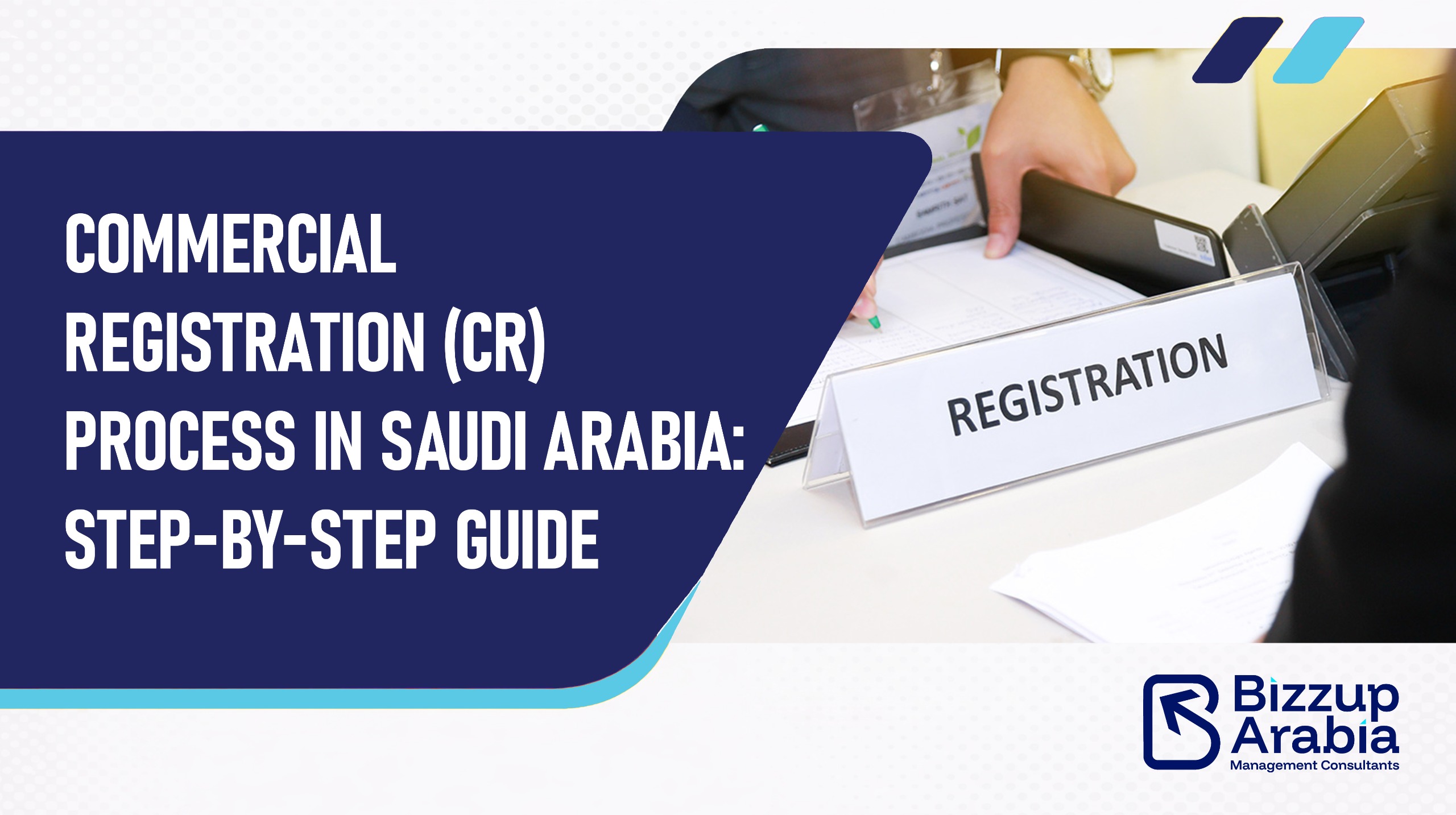
Step-by-Step Process to Obtain Commercial Registration in Saudi Arabia
One of the most important steps in setting up a business in Saudi Arabia is obtaining Commercial Registration (CR). If you're planning to start a business in the Kingdom, understanding how to obtain Commercial Registration in KSA is one of the most important steps. A Commercial Registration (CR) is required for almost every business activity, whether you're opening a consultancy, trading company, branch office, e-commerce business, or industrial operation.
What Is Commercial Registration (CR) in Saudi Arabia?
A Commercial Registration (CR) is the official certificate issued by the Saudi Ministry of Commerce (MoC) through the Saudi Business Center (SBC) platform that formally establishes a business as a recognized legal entity in the Kingdom. Every company operating in Saudi Arabia — whether a local sole proprietorship, a limited liability company (LLC), a joint-stock company, or a branch of a foreign multinational — must hold a valid CR before conducting any commercial activity. It is known locally as Sijil Tijari.
The CR certificate captures the core identity of your business:
- Legal trade name
- Unique CR number
- Legal form (LLC, sole proprietorship, joint-stock company, branch, etc.)
- Registered business activities (based on MoC's approved activity classification)
- Capital amount
- National address
- Date of issuance and, where applicable, ownership structure
Why CR Matters: Legal and Business Importance
A Commercial Registration (CR) is more than just a registration certificate — it is what makes your business officially recognized in Saudi Arabia. It allows:
- Legal recognition: Without a CR, your business has no legal standing to sign contracts, and any agreements you enter into may be unenforceable.
- Banking access: Saudi banks require a valid CR before opening any corporate account.
- Invoicing and taxation: You cannot legally issue invoices, register for VAT, or comply with e-invoicing (FATOORA) requirements without a CR.
- Government tenders: Public and semi-public sector contracts require bidders to hold an active, compliant CR.
- Visa and labor sponsorship: Hiring staff and sponsoring work visas through Qiwa and Muqeem is tied directly to your CR.
- Credibility and trust: A registered, verifiable CR signals transparent operation within Saudi commercial law.
- Access to municipal and sector licenses: Many follow-on licenses require an active CR as a prerequisite.
Who Needs a CR in Saudi Arabia?
This is the common question everyone asks: Do I really need a Commercial Registration (CR) to do business in Saudi Arabia? In most cases, the answer is yes. A CR is required for:
- Saudi nationals starting a sole proprietorship, partnership, or company
- GCC nationals conducting commercial activity in Saudi Arabia
- Foreign investors and multinational companies establishing an LLC, joint-stock company, or branch office
- Entrepreneurs and startups, including home-based and digital businesses
- E-commerce operators selling goods or services online to Saudi consumers
- Professional service providers (consultancies, engineering firms, legal and accounting practices)
- Freelancers operating above a certain scale wishing to formalize as a registered establishment
- Foreign companies bidding on Saudi government or Aramco-linked contracts
Eligibility Requirements
Before applying, confirm you meet the Ministry of Commerce's baseline eligibility criteria:
| Requirement | Detail |
|---|---|
| Minimum age | 18 years old |
| Nationality | Saudi national, GCC citizen, or foreign investor holding a valid MISA license |
| Government employment | Not permitted to hold a CR, barring limited legal exceptions |
| Digital identity | Verified account on National Single Sign-On (SSO) or Absher |
| Legal standing | No active commercial violations or court judgments barring trade practice |
| Existing registrations | Individuals must not already hold an active CR for another sole establishment |
| Minimum capital | SAR 5,000 minimum for companies (no fixed minimum for individual establishments) |
| Trade name | Unique, relevant to the activity, under 40 characters (Arabic, non-Arabic, or Arabized names permitted) |
| Registered address | A valid national address in Saudi Arabia, verified via Saudi Post (Sabil) |
Documents Required for Commercial Registration
Documentation requirements vary slightly by legal structure and applicant nationality. The table below shows each document and who it applies to.
| Document | Applies To |
|---|---|
| National ID (Saudi) or GCC national ID/passport | Saudi / GCC |
| Proposed trade name (with 2–3 backup options) | Both |
| Business activity description matching MoC's approved classification | Both |
| Proof of registered national address (Ejar-attested lease or title deed) | Both |
| Articles of Association (AoA) / Memorandum of Association (MoA) — notarized and Arabic-translated for foreign entities | Both |
| Capital declaration | Saudi / GCC |
| Power of attorney (if a representative is filing on the owner's behalf) | Saudi / GCC |
| Valid MISA investment license | Foreign Investors |
| Certificate of incorporation of the parent company (legalized and Arabic-translated) | Foreign Investors |
| Parent company board resolution authorizing establishment of the Saudi entity | Foreign Investors |
| Shareholder/director identity documents | Foreign Investors |
| Proof of financial standing / corporate solvency | Foreign Investors |
| Appointment letter for a local representative or service agent (where applicable) | Foreign Investors |
| Bank reference letter (in some cases, for capital verification) | Foreign Investors |
Step-by-Step Commercial Registration Process (2026)
The process below reflects the current streamlined workflow via the Saudi Business Center (SBC) platform.
- Choose Your Legal Structure
Decide whether you'll register as a sole proprietorship, LLC, joint-stock company, branch of a foreign company, or another recognized form. This decision affects liability, capital requirements, and future compliance obligations. - Obtain a MISA Investment License (Foreign Investors Only)
Secure an investment license from the Ministry of Investment (MISA), choosing from service, trade, industrial, professional, real estate, agriculture, mining, or entrepreneurial categories. Typically takes 5–7 working days. - Reserve Your Trade Name
Submit your proposed trade name through the MoC e-services portal. The system checks instantly for duplication and compliance. Arabic, non-Arabic, and Arabized names are all permitted. - Select Your Business Activity Classification
Choose your activity from MoC's approved classification list. An incorrect or overly broad selection is one of the most common causes of delay or rejection. - Draft and Notarize the Articles of Association (AoA)
Prepare the AoA/MoA defining ownership, capital contribution, governance structure, and management authority. Foreign documents must be legalized and Arabic-translated. - Register Your National Address
Enter your national address as registered with Saudi Post (Sabil), and attach an Ejar-attested lease or title deed. Certain digital activities may qualify for a "Work from Home" designation. - Submit the Online CR Application
Log in via National Unified Access, fill in the establishment information, upload all required documents, and submit for review. - Pay the Applicable Fees
Government fees vary by legal form and business size. Payment is completed electronically through the platform. - Receive Your CR Certificate
Issued electronically and immediately in most straightforward cases; manual review cases may take 1–3 additional business days. - Automatic Registration with Linked Authorities
Your business is auto-registered with MHRSD, ZATCA, GOSI, Saudi Post, and the Chamber of Commerce. You must still manually complete VAT/e-invoicing registration and open your corporate bank account.
Commercial Registration Costs and Government Fees
Commercial Registration costs in Saudi Arabia depend on the legal structure and business activity. In 2026, the CR fee is approximately SAR 500 for a sole proprietorship, SAR 1,200 for a Limited Liability Company (LLC), SAR 1,000 for a general or limited partnership, and SAR 1,600 for a joint-stock company, simplified joint-stock company, or foreign company branch.
Companies may also pay a SAR 500 publication fee, along with 15% VAT where applicable. Reserving a trade name costs SAR 200 for an Arabic name or SAR 500 for an English name. Foreign investors must complete Investment Registration with MISA before starting their activities; however, the registration service itself currently has no government fee.
Additional charges may apply for Chamber of Commerce membership, municipal licences and sector-specific approvals. These amounts vary according to the company's classification, activity and location. Office rent, document translation, legal support and consultancy services are separate business setup expenses and are not included in the official CR fee. Applicants should confirm the final costs through the Saudi Business Center before submitting their application.
Timelines: How Long Does CR Registration Take?
The timeline for obtaining a Commercial Registration (CR) depends on your business structure and whether you are a local entrepreneur or a foreign investor.
- Saudi and GCC businesses: Usually within 1–2 business days after submitting the application and required documents.
- Foreign investors: Normally 5–10 working days, depending on the MISA investment licence approval and document verification.
- Applications requiring manual review or additional approvals may take longer.
Why Choose Bizzup Arabia for Commercial Registration in Saudi Arabia?
Getting a Commercial Registration (CR) in Saudi Arabia can feel overwhelming, especially with all the rules and paperwork involved. Bizzup Arabia makes the process simple and straightforward.
We help you choose the right business activity, reserve your trade name, prepare the required documents, and handle the submission with the relevant authorities. For foreign investors, we also guide you through the MISA licensing requirements before applying for CR.
With our experience, we help avoid delays and common mistakes, making sure your registration is completed smoothly and on time.
Conclusion
Obtaining a Commercial Registration (CR) is a key step in setting up a business in Saudi Arabia. It allows you to operate legally, open a business bank account, register for VAT, hire employees, and take part in government projects. A valid CR also helps build trust with clients and partners in the market.
Working with an experienced business setup consultant in KSA like Bizzup Arabia can make the process much easier. Our experienced team can assist with everything from MISA licensing and Commercial Registration to handling government procedures and ongoing support after your business is established. If you are planning to start or expand your business in Saudi Arabia, getting the right guidance can help you move forward with confidence and avoid unnecessary delays.