

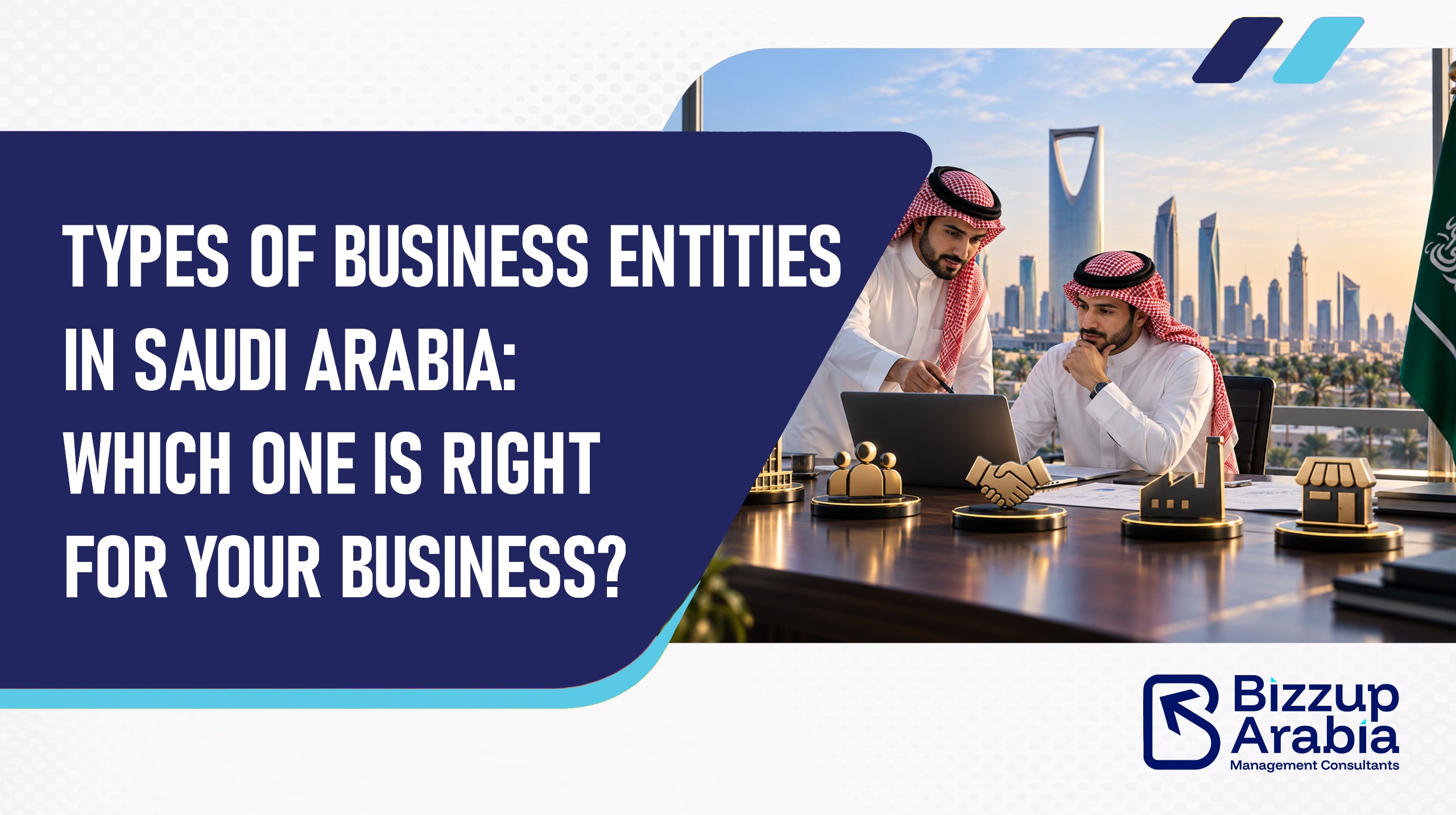
Starting a business in Saudi Arabia begins with one critical decision — choosing the right legal structure. Before you think about office space, hiring, or operations, you need to know what type of business entity fits your goals. Get it right, and everything that follows — banking, licensing, visas, taxes — falls into place. Get it wrong, and restructuring later can cost you time, money, and market opportunities. At Bizzup Arabia, we help entrepreneurs and investors navigate this decision every day. This guide breaks down every major business entity available in Saudi Arabia, who each one is for, and how to choose the right one for your situation.
What Are the Main Types of Business Entities in Saudi Arabia?
Saudi Arabia recognizes several legal structures under the Companies Law (Royal Decree M/132, 2022). Here is a quick overview before we go deeper:
- Limited Liability Company (LLC)
- Simplified Joint Stock Company (SJSC)
- Joint Stock Company (JSC)
- General Partnership
- Individual Establishment (Sole Proprietorship)
- Branch of a Foreign Company
- Representative or Liaison Office
- Regional Headquarters (RHQ)
- Holding Company
- Professional Company
-
Limited Liability Company (LLC)
The LLC is the most popular business structure in Saudi Arabia — and for good reason. Each shareholder's liability is limited to the capital they invest, which means your personal assets are protected if the business faces debt or legal claims.
Key facts:
● 1 to 50 shareholders allowed
● No minimum capital requirement for most activities
● Can be 100% foreign-owned in most sectors
● Managed by appointed managers, not a mandatory board
Single-member LLC — Since 2022, one person or company can form an LLC alone, without a second partner. This is ideal for foreign investors who want a clean, wholly-owned Saudi subsidiary.
Multi-member LLC — Works well for joint ventures, family businesses, and Saudi–foreign partnerships. Profit-sharing and management terms are set in the articles of association.
Why SMEs prefer the LLC:No fixed minimum capital for most activities
Lighter governance requirements than a JSC
Faster registration timelines
No mandatory public financial disclosures
-
Simplified Joint Stock Company (SJSC)
The SJSC is a newer structure introduced by the 2022 Companies Law specifically for startups and growth-stage companies. It bridges the gap between an LLC and a full joint stock company.
Key facts:
● Minimum capital: approximately SAR 5,000
● Can issue multiple share classes (ordinary, preferred, redeemable)
● Lighter governance than a full JSC
● Ideal for staged fundraising
Unlike an LLC, an SJSC lets you offer preferred shares with investor-friendly rights like liquidation preference and anti-dilution protection. This makes it significantly easier to raise venture capital across multiple funding rounds. -
Joint Stock Company (JSC)
The JSC is the most formally governed company structure in Saudi Arabia. It is the only structure that can list shares on Tadawul (the Saudi Stock Exchange).
Key facts:
● Minimum capital: SAR 500,000
● Required for banking, insurance, and finance businesses
● Subject to formal board of directors and general assembly requirements
● Public JSCs are regulated by the Capital Market Authority (CMA) -
General Partnership
In a general partnership, all partners share management and carry unlimited personal liability for the firm's debts. Every partner is personally responsible for the full amount of the business's obligations — not just their share. This unlimited liability makes general partnerships rare among serious commercial businesses. Most investors prefer the protection of an LLC or SJSC instead.
-
Individual Establishment (Sole Proprietorship)
An individual establishment — known in Arabic as mu'assasah fardiya — is the simplest way to trade as an individual. There is no separate legal entity; the business and the owner are legally the same person. This means your personal assets — home, savings, everything — are fully exposed to business liabilities. Foreign investors almost always choose a single-member LLC instead, since it offers the same simplicity with the added protection of limited liability.
-
Branch of a Foreign Company
A branch is not a new Saudi legal entity. It is a registered extension of your existing foreign company, operating under the parent's name and legal identity in Saudi Arabia. Because the branch has no separate legal personality, the foreign parent company carries full liability for everything the branch does in the Kingdom. Branches are commonly used by foreign contractors executing a specific government or private-sector project.
Important: Operating in Saudi Arabia for more than 183 days within any 12-month period — even without a registered branch — can trigger a "permanent establishment" and create corporate income tax obligations. Register proactively to avoid this. -
Representative or Liaison Office
A representative office lets a foreign company maintain a presence in Saudi Arabia for market research, promotion, and liaison activities — without conducting commercial transactions or generating revenue locally. It cannot trade or invoice customers in the Kingdom, so it is not a long-term business vehicle. It is best used as a first step for companies evaluating whether the Saudi market fits their strategy before committing to full incorporation.
-
Regional Headquarters (RHQ)
Saudi Arabia's RHQ program invites multinational companies to centralize their regional management functions in the Kingdom. In exchange, qualifying companies receive meaningful incentives including corporate tax and withholding tax relief. To qualify, the parent company must be operating in at least two countries outside Saudi Arabia, and the RHQ must begin its mandatory functions within six months of licensing.
How Does Saudi Arabia Tax Each Business Structure?
This surprises many first-time investors: Saudi Arabia's tax system is based on who owns the company, not which entity type you choose.
| Ownership | Tax Applied | Rate |
| 100% Saudi / GCC-owned | Zakat only | 2.5% of Zakat base |
| 100% Foreign-owned | Corporate Income Tax (CIT) only | 20% of net taxable profit |
| Mixed Saudi–foreign | Both, apportioned | 2.5% on local share / 20% on foreign share |
Other key tax points:
● VAT is 15% on most goods and services
● Tax returns are due within 120 days of the fiscal year end
● Zakat and CIT cannot offset one another in mixed-ownership companies
● Oil and hydrocarbons sectors face higher tax rates than the standard 20% CIT
How to Choose the Right Business Structure?
Ask yourself these five questions before deciding:
- Who owns the business? Foreign-owned businesses must register with MISA before incorporating. Most sectors now allow 100% foreign ownership, but a small negative list of restricted activities still requires a Saudi partner.
- What activity will you carry out? Your business activity can determine which structures are available to you. Banking and insurance require a JSC. Professional services may require a professional company. Check MISA's licensed-activities list first.
- How much personal liability are you comfortable with? LLCs, SJSCs, and JSCs offer limited liability. General partnerships and individual establishments do not. For most investors, this alone narrows the choice significantly.
- How big is your business today — and where is it headed?
●Solo founder or small business → Single-member LLC
● SME → Multi-member LLC
● Startup raising VC → SJSC
● Large or regulated business → JSC
● Multinational with regional management → RHQ -
What are your expansion plans? If you plan to raise institutional investment, an SJSC's flexible share classes age better than an LLC. If you plan to list on Tadawul eventually, start planning toward a JSC structure early.
How to Set Up a Business in Saudi Arabia: Step by Step
- Choose your activity and legal structure — Confirm your activity against MISA's licensed-activities list.
- Reserve a trade name — Register your company name with the Ministry of Commerce.
- Obtain Investment Registration (foreign investors only) — Apply to MISA for an Investment Registration Certificate before incorporation.
- Draft and notarize the articles of association — Prepare founding documents via the Ministry of Justice's electronic notarization platform.
- Register with the Ministry of Commerce — Submit documents to obtain your Commercial Registration (CR).
- Complete post-incorporation registrations — Register with ZATCA (tax), GOSI (social insurance), and the Chamber of Commerce.
- Open a corporate bank account and secure sector approvals — Obtain any additional activity-specific licenses.
- Set up visas and sponsorships — Register with the Ministry of Human Resources to sponsor Iqamas for foreign employees.
A straightforward LLC with complete documents can often be registered within a few weeks. Regulated activities and JSC structures typically take longer due to additional approval requirements.
Conclusion
Choosing the right business entity in Saudi Arabia isn't just a legal formality — it's the foundation your entire business is built on. The structure you pick today will shape your tax obligations, your ability to raise capital, your personal liability exposure, and how smoothly you can scale tomorrow.
The good news? Saudi Arabia has never been more open to business. Vision 2030 has unlocked 100% foreign ownership across most sectors, streamlined registration processes, and introduced new structures like the SJSC that give modern businesses exactly the flexibility they need.
But with more options comes more responsibility to choose wisely. An LLC is the right answer for most — but not all. A startup with investor ambitions needs an SJSC. A regulated business needs a JSC. A multinational managing regional operations needs an RHQ. There is no universal answer, only the right answer for your specific goals.
At Bizzup Arabia, we've helped hundreds of entrepreneurs and investors set up businesses in Saudi Arabia — the right way, from day one. Whether you're still deciding on a structure or ready to start the registration process, our team is here to make it simple, fast, and stress-free.